
The Converged Threat Landscape
The primary threat to business continuity is no longer simple hardware failure; it is the sophisticated, pervasive cyber attack, particularly ransomware. Malware now specifically targets backup systems, replication infrastructure, and recovery mechanisms, transforming a disaster recovery (DR) event into a catastrophic data loss scenario. Achieving true organizational resilience demands that Cyber Security (Sec) is no longer a separate domain from Disaster Recovery (DR).
Crucially, reliance on traditional DR—which restores data based on time (RPO) and speed (RTO) without verifying cleanliness—leaves organizations vulnerable to re-introducing latent malware back into production. This is known as “restoring the bad guys.”
Our specialized Malware Resilience and Secure Recovery Services are engineered to address this converged threat. By integrating security controls, immutable storage, and automated validation directly into the DR workflow, organizations can ensure that recovery is not only fast but also secure and verifiable, safeguarding the business from operational paralysis and reputational damage.
The Challenge: Siloed Security and Compromised Recovery
Our client, a high-value data enterprise (or a company that experienced a near-miss ransomware event), was grappling with a security program that was disconnected from its recovery capabilities. They had strong perimeter defenses but weak internal resilience. This lack of integration led to:
- Corrupted Recovery Points: Malware remained dormant in backup images or replicated volumes for weeks before detonation, meaning that by the time the attack occurred, all viable recovery points were already compromised.
- Lack of Air-Gapped or Immutable Storage: Backup data was accessible via standard network protocols, making it a primary target for encryption or deletion by the malware itself, rendering the DR plan useless.
- Blind Restoration Risk (Restoring the Threat): The DR process was designed solely for speed (low RTO) and lacked any mechanism to scan or validate recovery images before they were promoted to production, guaranteeing the re-infection of the environment.
- Regulatory Reporting and Audit Failures: The inability to confidently prove that recovered data was clean and that recovery systems met specific immutability standards created significant compliance and audit risks.
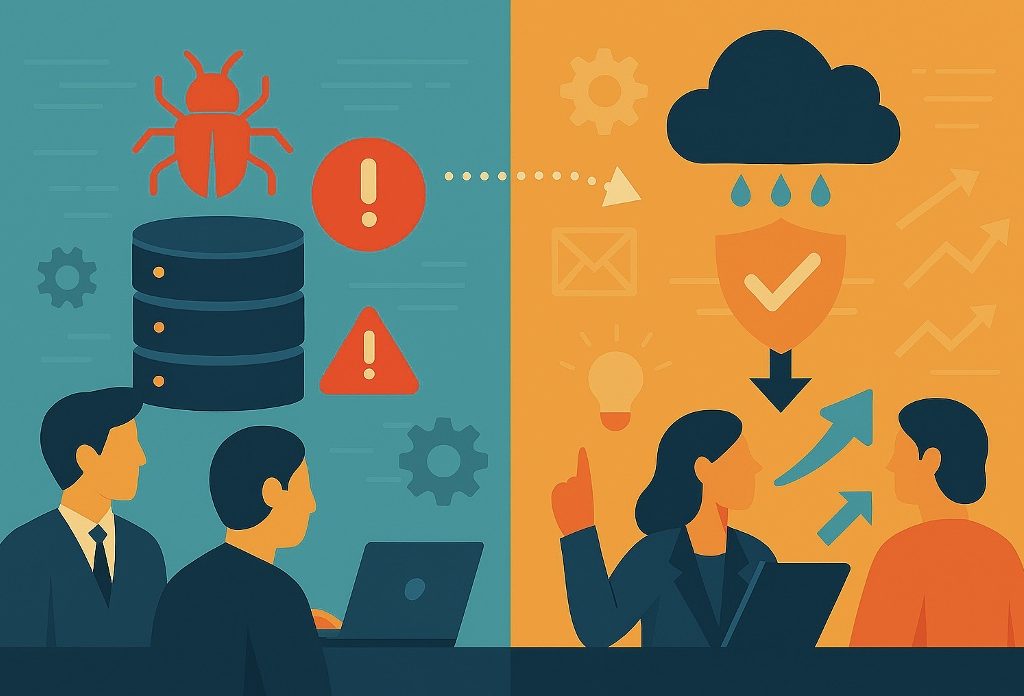
Our expert team initiated a comprehensive Cyber Resilience assessment, analyzing the gap between their security tools (EDR/SIEM) and their recovery platforms (backup/replication). This deep-dive allowed us to develop a strategic, phased roadmap for establishing an immutable recovery architecture—a unified, secure, and verifiable framework designed to defeat modern cyber threats.
Our Solution: Implementing an Immutable, Integrated Recovery Architecture
The resilience strategy focused on establishing a secure, isolated recovery process and leveraging security analytics to validate recovery points. Key phases included:
Discovery & Assessment (Resilience vs. Security Mapping)
Detailed analysis of the current attack surface, existing backup topology, and security event correlation. This phase includes a Recovery Point Integrity Check to assess the risk of dormant malware across all existing backup sets.
Design & Architecture (Secure Recovery Blueprint)
Development of a target cyber resilience architecture leveraging specialized controls. The design specifically incorporates:
- Immutable and Air-Gapped Storage: Implementing a “Write Once, Read Many” (WORM) storage solution or a physical/logical air-gap strategy to protect backup copies from modification or deletion by the malware.
- Isolated Recovery Environments (IREs): Creating a segregated, “clean room” network sandbox where recovered systems can be safely booted, scanned, and forensically examined before being cleared for production return.
- Integrated Security Scanning: Deploying advanced security tools (e.g., EDR) within the recovery workflow to automatically scan recovered images for malicious artifacts before they exit the clean room and rejoin the corporate network.
Implementation & Validation (Secure Failover Testing)
Executing the platform migration and then performing rigorous, threat-based DR testing. This includes periodic, full-scale failover simulations where a known benign threat is introduced to test the recovery system’s ability to isolate, scan, and quarantine the compromised workload, ensuring the recovery process is secure and validated.
Measurable Impact & Key Outcomes: Verifiable Clean Recovery
The successful execution of our Malware Resilience project yielded profound, measurable benefits:
Guaranteed Data Integrity and Clean Recovery
Eliminated the risk of re-introducing malware by making security validation an automated, mandatory step in the DR process.
- Outcome: Achieved 100% confidence in the security posture of restored systems, drastically reducing the risk of a secondary, more damaging attack.
Substantial Reduction in Recovery Time (RTO) During Cyber Attack
Automated the security scanning and isolation process, which typically adds days to a manual recovery timeline.
- Outcome: Reduced the total recovery duration (RTO) for a cyber incident by over 60%, moving from multiple days of forensic cleanup to hours of automated validation.
Enhanced Compliance with Cyber Insurance and Regulatory Mandates
Provided automated, verifiable reporting that documents the immutability of backups and the security validation of all recovered data.
- Outcome: Simplified regulatory and cyber insurance audits by proving the capability for secure, verifiable restoration, often leading to better policy terms.
Future-Proofing Against Evolving Ransomware Tactics
The layered, integrated approach ensures that recovery architecture protects against future strains of malware designed to target recovery infrastructure.
- Outcome: Established a resilient foundation that can easily integrate new threat intelligence and scanning technologies without redesigning the entire DR architecture.
Why Choose Our Malware Resilience Services?
We understand that recovery is the last line of defense against cyber threats. We are experts in converging modern backup platforms (e.g., Rubrik, Veeam, Commvault) with leading security tools (e.g., SentinelOne, CrowdStrike, Splunk) to create a unified, defensive architecture. We integrate a security-validated recovery methodology to deliver solutions that provide a measurable and impactful return on investment (ROI) in business continuity.
Partner with us to transform your separate security and recovery functions into a single, cohesive, and unbreakable cyber resilience strategy.