
The DBaaS Imperative in Modern Data Strategy
In today’s competitive landscape, enterprise success is intrinsically linked to data agility, rapid application deployment, and continuous innovation. However, the foundational systems that manage this database are often saddled with complexity. Organizations face immense pressure to maintain robust performance, implement stringent security, and ensure 24/7 availability while simultaneously managing explosive data growth.
Crucially, reliance on traditional, manually intensive Database Administrator (DBA) operations leads to inflated operational expenditures (OpEx), slow provisioning times, and a constant struggle to hire and retain highly specialized database talent.
Our specialized Database as a Service (DBaaS) and Outsourced DBA Management solutions are engineered to address these challenges. By transitioning to a consumption-based, automated DBaaS model, organizations can streamline operations, substantially reduce total cost of ownership (TCO), and strategically position themselves for sustainable, scalable growth under a unified, elastic, and high-performance data framework.
The Challenge: Legacy Database Management, OpEx Drag, and Talent Scarcity
Our client, a prominent mid-sized technology firm (or an organization dealing with rapidly scaling customer data), was grappling with a complex, siloed database environment. They managed multiple relational and NoSQL databases across diverse infrastructure stacks. This architecture led to:
- Talent and Cost Overheads: High costs associated with hiring, training, and retaining a large, internal team of dedicated DBAs required for routine, non-strategic maintenance (patching, backups, monitoring).
- Operational Inefficiency & Slow Provisioning: Provisioning new database environments took days or weeks due to manual configuration and capacity planning. This friction severely hindered developer productivity and time-to-market for new applications.
- Inconsistent Security & Patching Gaps: Non-standardized maintenance schedules and manual patching created vulnerability windows, increasing the risk of security breaches and audit failures.
- Scaling and Reliability Headaches: Difficulties in rapidly scaling compute and storage resources up or down in response to fluctuating demand, often leading to performance bottlenecks during peak usage.
Our expert team initiated a comprehensive data landscape assessment, analyzing all database types, performance demands, workload patterns, and data governance requirements. This deep-dive allowed us to develop a strategic, phased roadmap for migrating and consolidating their disparate databases into a unified, high-performance, resilient, and automated DBaaS model.
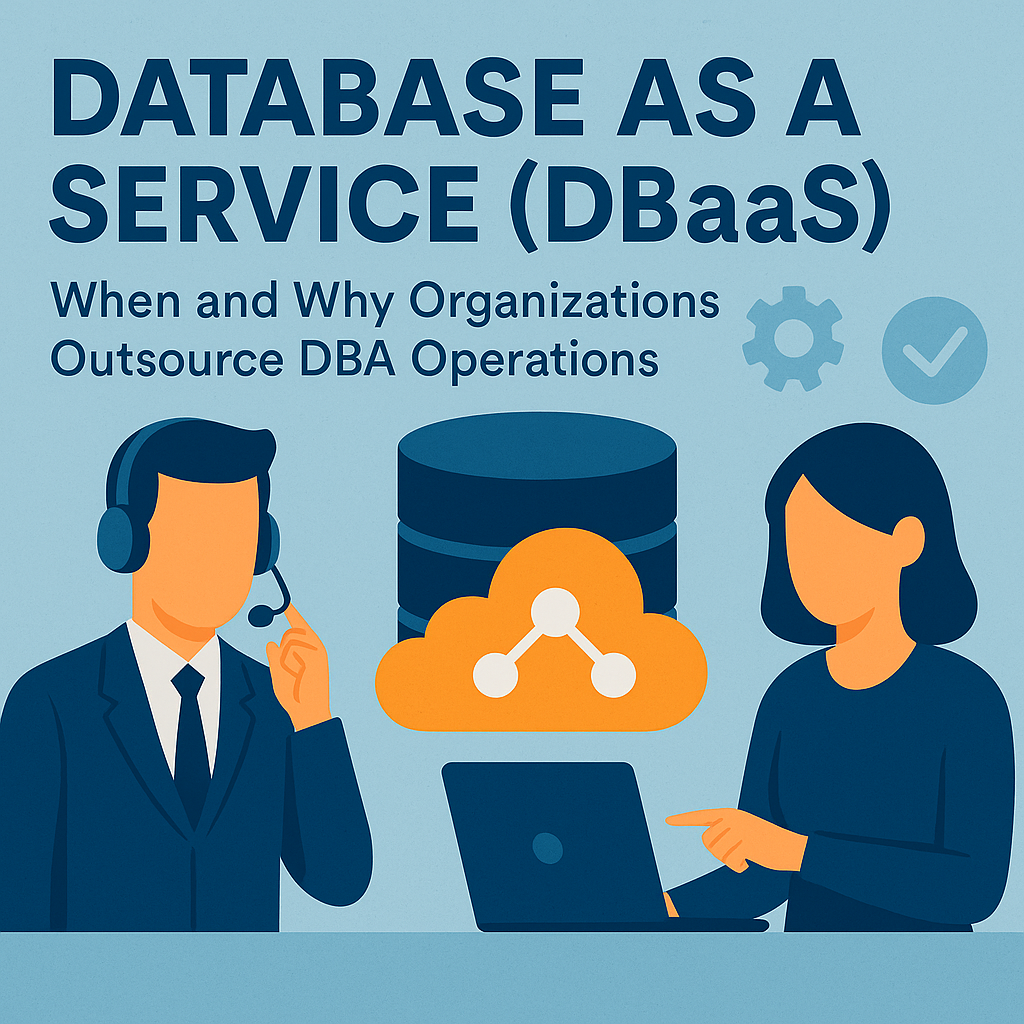
Our Solution: Leveraging DBaaS for Automated, Scalable, and Optimized Data Management
The DBaaS adoption strategy focused on automation, elastic scaling, and leveraging our specialized DBA expertise for strategic oversight. Key phases included:
Discovery & Assessment (Workload Analysis)
Detailed analysis of existing database architecture, schema dependencies, query performance, and licensing. This phase also includes a DBaaS Readiness Assessment to map existing workloads to optimal cloud-native or specialized DBaaS platforms (e.g., fully managed services from AWS, Azure, Google Cloud, or dedicated platform providers).
Design & Architecture (Automation and Scalability)
Development of a target state data architecture leveraging the core principles of DBaaS. The design specifically incorporates:
- Automated Lifecycle Management: Utilizing platform features for self-healing, automated backups, point-in-time recovery, and zero-downtime patching.
- Elastic Scaling: Implementation of auto-scaling capabilities for compute and storage, ensuring performance meets demand instantly without over-provisioning.
- Security by Design: Configuration of network isolation, automated encryption at rest and in transit, and Unified Identity & Access Management (IAM) built into the DBaaS platform.
Migration & Validation (Performance Assurance)
Executing low-risk, phased database migration (e.g., using native tools or third-party replication) followed by rigorous performance tuning and stress testing of all migrated workloads to ensure stability and maximum efficiency within the new managed environment.
Measurable Impact & Key Outcomes: Data Agility as an Outcome
The successful execution of our DBaaS adoption and DBA outsourcing project yielded profound, measurable benefits:
Substantial Total Cost of Ownership (TCO) Reduction
Eliminated the need for significant CapEx investment in database hardware and drastically reduced OpEx by outsourcing routine maintenance tasks.
- Outcome: Achieved an average 35% reduction in total database management costs within the first year.
Accelerated Time-to-Market (TTM)
Reduced the time required to provision new database instances from weeks to mere minutes.
- Outcome: Accelerated application development cycles, enabling developers to self-service database environments and pushing new features to market significantly faster.
Improved Reliability & Uptime
Leveraged the inherent high availability, automated failover, and self-healing features of the DBaaS platform.
- Outcome: Drastically improved Recovery Point Objectives (RPO) and Recovery Time Objectives (RTO), ensuring superior business continuity and data integrity.
Internal Talent Reallocation to Strategic Work
Freed up expensive internal DBA staff from routine, maintenance-heavy tasks.
- Outcome: Reallocated internal data experts to focus exclusively on strategic initiatives, like data architecture optimization, innovation, and advanced analytics.
Why Choose Our DBaaS & DBA Outsourcing Services?
We understand the critical balance between performance, cost efficiency, and leveraging specialized expertise. We are platform-agnostic, advising clients on the optimal mix of cloud-native DBaaS and outsourced managed services for platforms like PostgreSQL, MySQL, SQL Server, MongoDB, and more. We integrate a security-first methodology to deliver solutions that provide a measurable and impactful return on investment (ROI).
Partner with us to transform your database management from a constant operational challenge and cost sink into a strategic, agile, and automated engine for business success.